
How to Choose a Compact Tractor Snow Plow That Won’t Destroy Your Machine
If you've got a long driveway, some woods to keep clear, and a compact tractor you use for everything from firewood to storm cleanup, you already know what that tractor’s worth to you. So here's the problem: a lot of the snow plows sold for compact tractors aren't built for compact tractors. Instead, they're cut-down skid-steer blades or generic gear that happens to bolt on, and bolting on isn't the same as fitting right.
At Earth and Turf Attachments, we've seen what happens when the wrong plow meets the wrong tractor. Overweight blades that strain the loader; mounting hardware that was never engineered for a 30 or 40 horsepower frame; bent loader arms and cracked front ends that show up as a warranty claim nobody wants to file. If you're plowing a 400-foot driveway with your tractor, the last thing you need is to buy a snow plow twice because the first one broke, or to send your tractor to the shop because the plow strained your machine.
Here's what we've learned from years of plow failures and warranty calls, and how you can avoid repeating them on your own tractor.
TL;DR: How to Choose a Compact Tractor Snow Plow
Not enough time to read? Here’s the short version.
- Match Size and Weight: Ensure the plow is within 50% of your tractor's rated lift capacity to avoid hydraulic or frame damage.
- Size Blade to Tractor: Choose a width that extends slightly beyond your tires when the plow is angled; a blade that is too wide puts unnecessary stress on your loader and frame.
- Use Compact-Specific Gear: Avoid generic or skid-steer attachments; choose mounts and blades engineered specifically for your compact tractor's geometry.
- Balance Your Machine: Add rear ballast (box, weights, or fluid) to maintain traction and steering control when you mount a heavy plow up front.
- Prioritize Quality and Warranty: Choose a manufacturer that offers a robust warranty and supports their product, ensuring you have expert help if something fails.
Start With Your Tractor's Size and Weight
Your tractor's size and weight set the ceiling for everything else. A compact or sub-compact tractor has a rated lift capacity for its loader, and that number tells you how much plow it can carry safely, day after day, without straining the hydraulics or the frame. A good rule is to plan around 50 percent of that rated capacity, then subtract the attachment's weight, so you have real margin left over. We walk through this math step by step in our 6-step guide to matching an attachment to your tractor. It was written with grapples in mind, but the same steps apply to sizing a plow.
Weight isn't just about the loader, either. A plow mounted out front shifts weight forward, which pulls it off your rear tires and steering axle. On a hill or a patch of ice, that matters. The fix is rear ballast, weight added to the back of the tractor, whether that's wheel weights, a ballast box, or tire fluid, so the rear end stays planted and you keep traction and steering control. We cover the sizing math and the options in The Balancing Act: A Guide to Ballast Boxes for Compact Tractors.
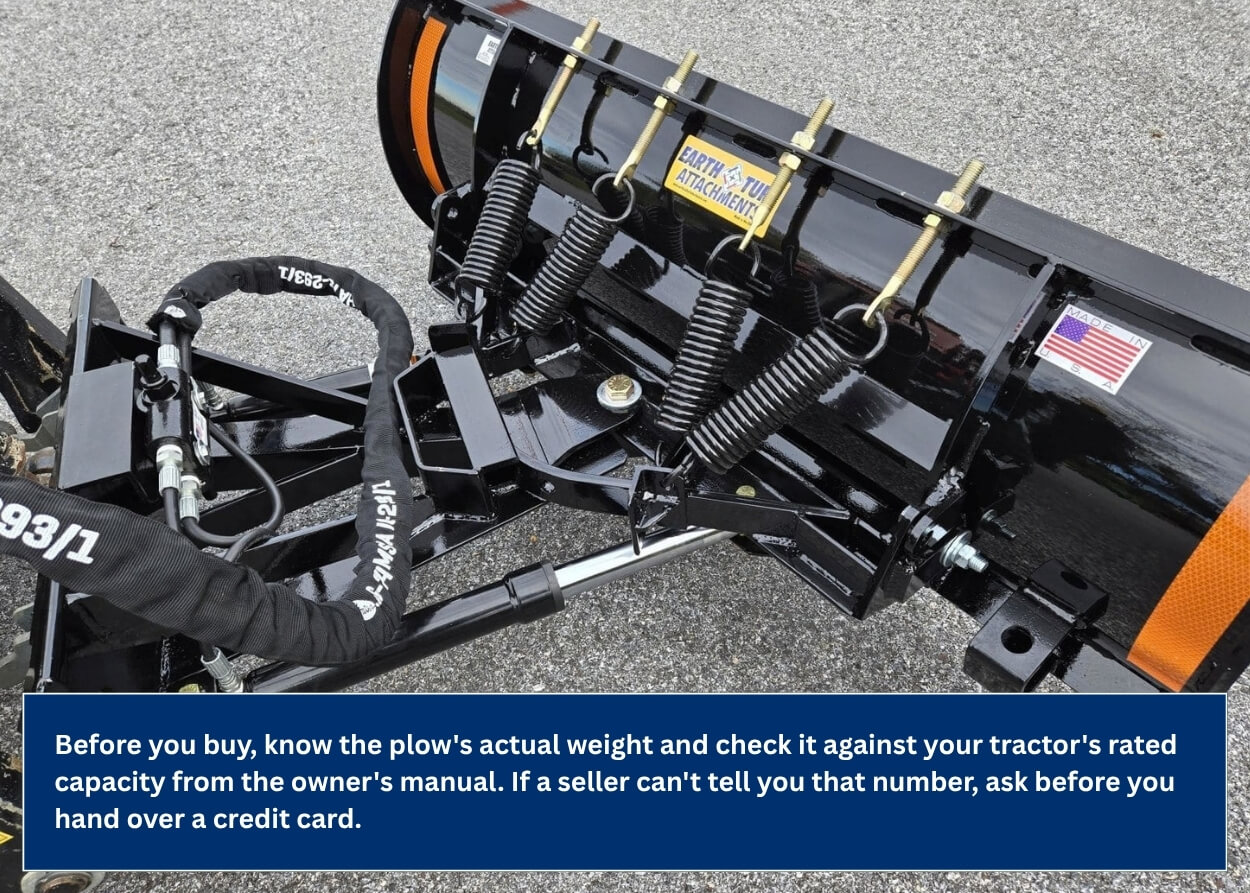
Before you buy, know the plow's actual weight, not just its price or blade size, and check it against your tractor's rated capacity from the owner's manual. If a seller can't tell you that number, ask before you hand over a credit card.
Get the Blade Width Right for Your Tractor, Not Your Driveway
It's tempting to buy the widest blade you can find so you clear more snow per pass. We get it, you want to get it over with and settle down on your couch with a hot mug of coffee. But a blade too wide for your tractor's frame catches extra resistance every time it hits a drift, and that force slowly but surely twists into the frame, pins, and mounting brackets one push at a time.
As a rule of thumb, the blade should extend a few inches past your outer tires on each side when the plow is angled, wide enough to clear a full path without hanging so far out that it fights your tractor on every pass. A 25 horsepower tractor and a 40 horsepower tractor plowing the same driveway need different blade sizes, not the same one in two colors. If you're stuck between two widths, the smaller one paired with an extra pass is almost always the safer, longer-lasting choice. Our own guide to snow pushers for compact tractors walks through matching width to your property and your tractor's hitch, not just the size of the job. Snow pushers should not be used to explain snowplows
This is where "buy once, not twice" really shows up. A right-sized blade clears your driveway just as fast in practice, since you're not fighting the machine on every drift. A blade sized wrong wears out loader arms and pins years early, and you end up replacing hardware, or the whole plow, before you planned to.
Choose a Mounting Type Built for Compact Tractors
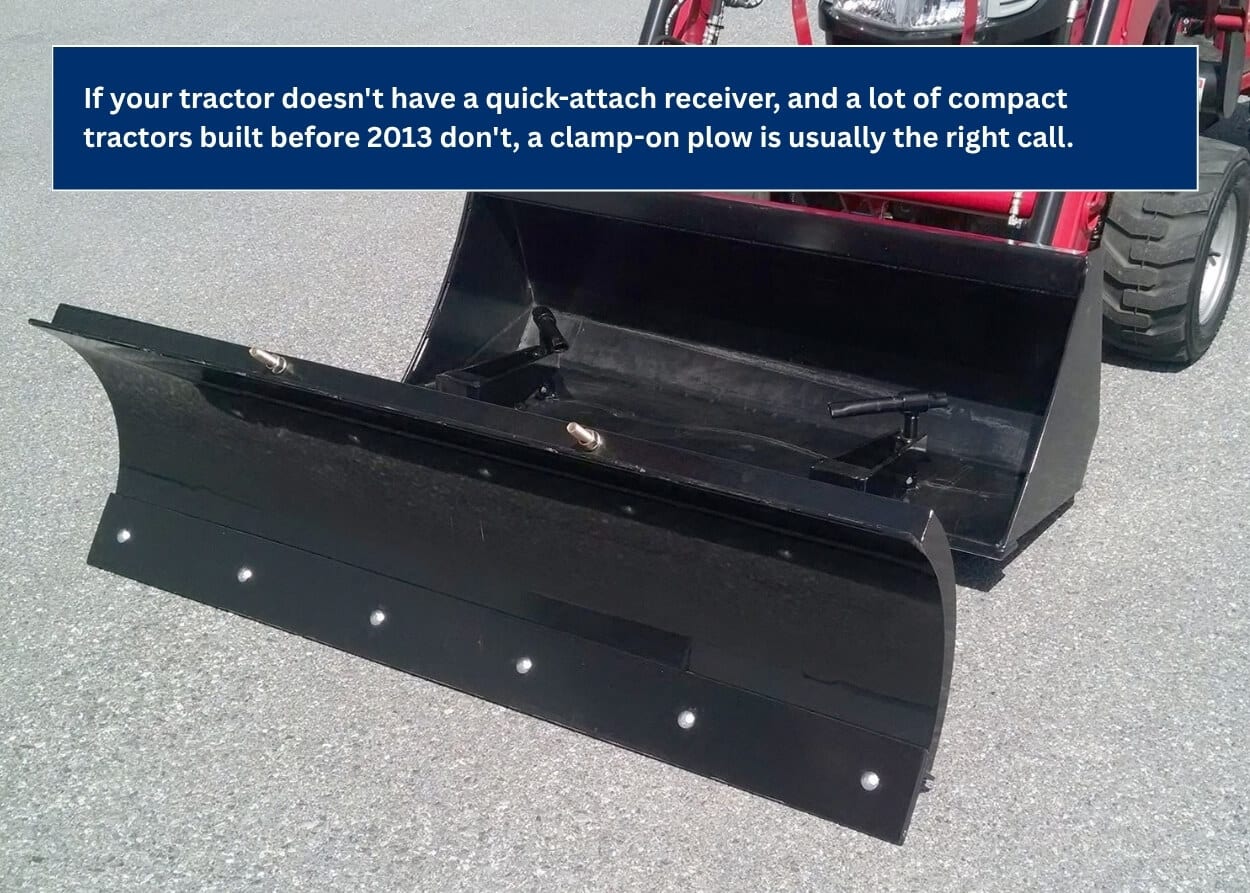
How the plow attaches to your tractor affects both how easy it is to use and how much wear it puts on the machine over time. If your tractor doesn't have a quick-attach receiver, and a lot of compact tractors built before 2013 don't, a clamp-on plow is usually the right call. Ours uses a wide underframe that runs 10 to 11 inches back under the bucket, with heavy-duty clamps that stiffen the bucket itself instead of just gripping the edge. We cover how these systems work, and when they make more sense than a quick-attach, in our blog about clamp-on attachments for tractor loaders. A clamp-on blade also needs to run about 12 inches wider than your bucket so snow doesn't pile up in it as the blade angles, which we walk through in our guide to choosing the correct snow plow.
If your tractor already has quick-attach, or you're weighing a front mount against a rear, three-point hitch plow, the tradeoffs shift again. Front mounts are easier to steer since you're facing forward, but many need a sub-frame, and you'll pull the plow to use the bucket. Rear plows cost less and leave your loader free, but pushing snow backward stresses the blade and means a lot of looking over your shoulder. Ask Tractor Mike covers these tradeoffs in more detail.
Whatever you pick, make sure it was engineered for a compact tractor's geometry, not adapted from something built for a bigger machine.
Another practical choice is whether you want manual or hydraulic angle control. A manual plow costs less, but you'll have to get off the tractor to reset the angle by hand every time the wind shifts or you switch directions. A hydraulic plow lets you angle it from the seat, which matters more than it sounds once you're doing it in the dark at six in the morning before work.
Look Past the Price Tag to the Warranty Behind It
A low price on a snow plow usually means someone cut a corner, and often it's the steel gauge, the mounting hardware, or the warranty. So before you buy, ask yourself: what happens if something bends or fails in year two?
A real warranty shows the manufacturer trusts its own engineering. No warranty, or one full of exceptions, tells you the opposite. A few things worth asking a seller directly:
- How long is the plow warranted for, and what does it actually cover?
- Who do you call if a weld cracks or a pin wears out: a call center or a real person who built the thing?
- How fast can you get parts if you're mid-storm and something breaks?
A good warranty and a real person on the other end of the phone are proof the manufacturer expects the plow to hold up, not just to sell. A short warranty, or one written around excuses, usually means the company doesn't expect the plow to see many hard winters, and that's not something you want to find out the first time you have issues.
Know the Difference Between Generic and Compact-Specific Engineering
This is the part that a lot of tractor owners don’t realize. A plow scaled down from a skid-steer blade might look like a fit, but skid-steers and compact tractors carry weight differently, mount differently, and handle side-load differently. It’s all about engineering and physics: Gear built for one doesn't automatically belong on the other.
Compact-specific engineering shows up in details you might not notice until they matter: a trip edge that flexes when it hits a curb instead of sending the shock straight into your loader pins, steel and hardware built to protect the blade from that kind of impact, and mounting brackets sized for a compact frame instead of bolted on with an adapter kit. None of it is flashy. All of it is the difference between a plow that lasts ten winters and one that needs welding after its first rough storm.
We hear this often enough that it's not a fluke. Someone bolts on a plow built for something bigger because it was cheaper or available locally, and within a season or two the loader arms bend, or a mounting pin wears oval. It's rarely one big mistake, just a plow that was never sized for that machine, doing its job the only way it knows how.
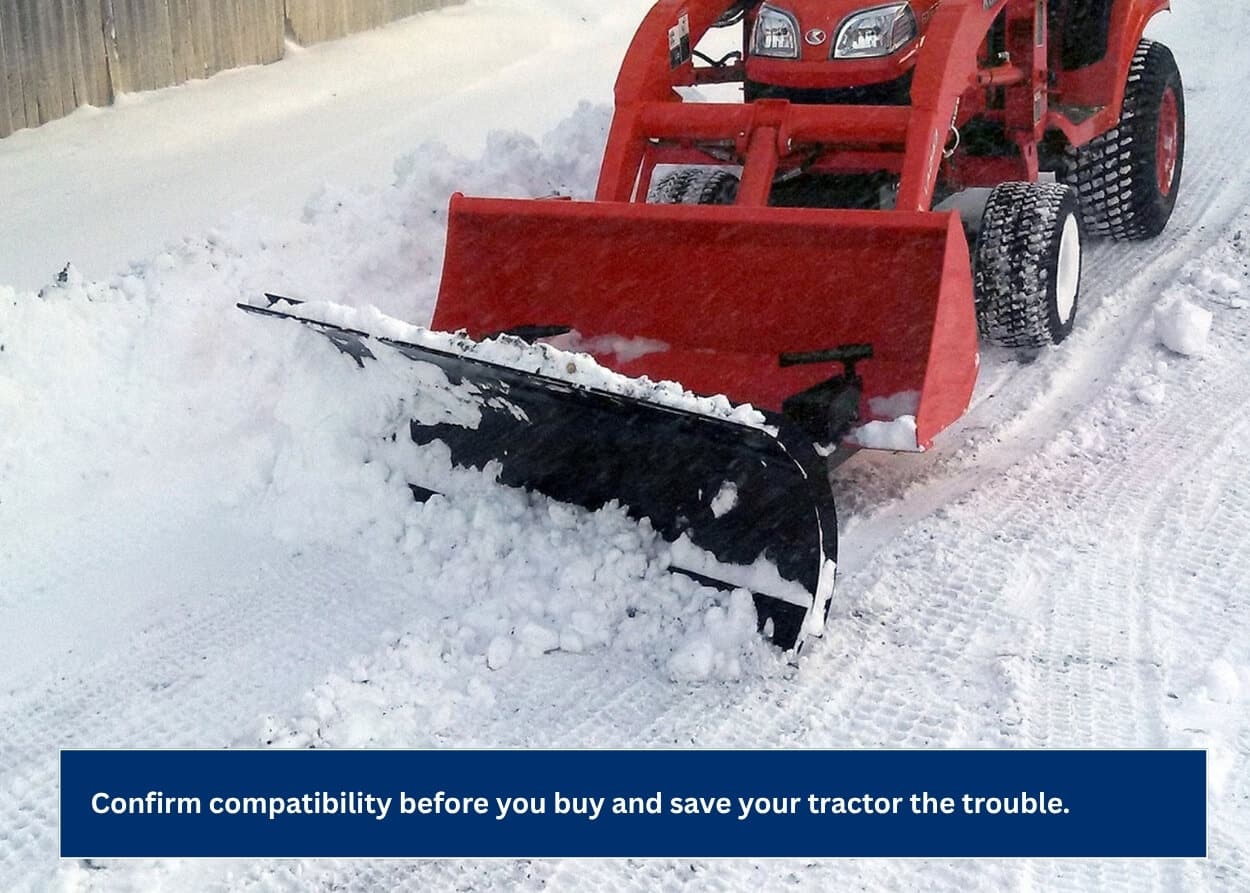
So do your tractor a favor: confirm compatibility before you buy.
What We Build, and Why
At Earth and Turf Attachments, we build our snow plows in Lancaster County, Pennsylvania, specifically for compact tractors, not scaled down from something built for bigger equipment. Every plow we ship carries a 5-year warranty because we've engineered them to hold up, and we want you to know that before you buy, not after. If a bracket doesn't fit right or a part wears out, you're calling people who know the metal and the machines, not a script.
Protecting your tractor is the whole point. It's often the most expensive piece of equipment you own, and it should still be running strong long after the plow has paid for itself in cleared driveways.
So imagine this coming winter: the snow's still coming down, but your driveway's already clear, the blade rides smoothly over the bumps without jarring your loader arms, and your tractor goes back in the barn ready for tomorrow. That's what happens when the plow actually fits the machine.
See our compact tractor snow plows to find the setup built for your tractor, or if you're not sure what your specific model can handle, talk to us. Send us your tractor's make and model, and we'll help you get it right the first time.
