
How To Match a Grapple to Your Tractor: A 6-Step Sizing Guide
So you found a grapple online that looked perfect for your tractor. The price was right, the photos looked great, so you hit "buy." But when it finally showed up, and you bolted it on, something felt off. Your tractor's front end sagged under the weight, the hydraulics groaned on the first lift, and you could barely pick up half of what you expected.
Sound familiar? You're not alone.
Chances are, it’s not that the grapple is lousy. You just didn’t get the right grapple.
Most advice on choosing the right grapple for your tractor focuses on which type to buy — root, brush, rock, or multi-purpose. That's helpful. But it skips the question that actually decides whether your grapple works or sits in the barn: Does it fit your specific tractor?
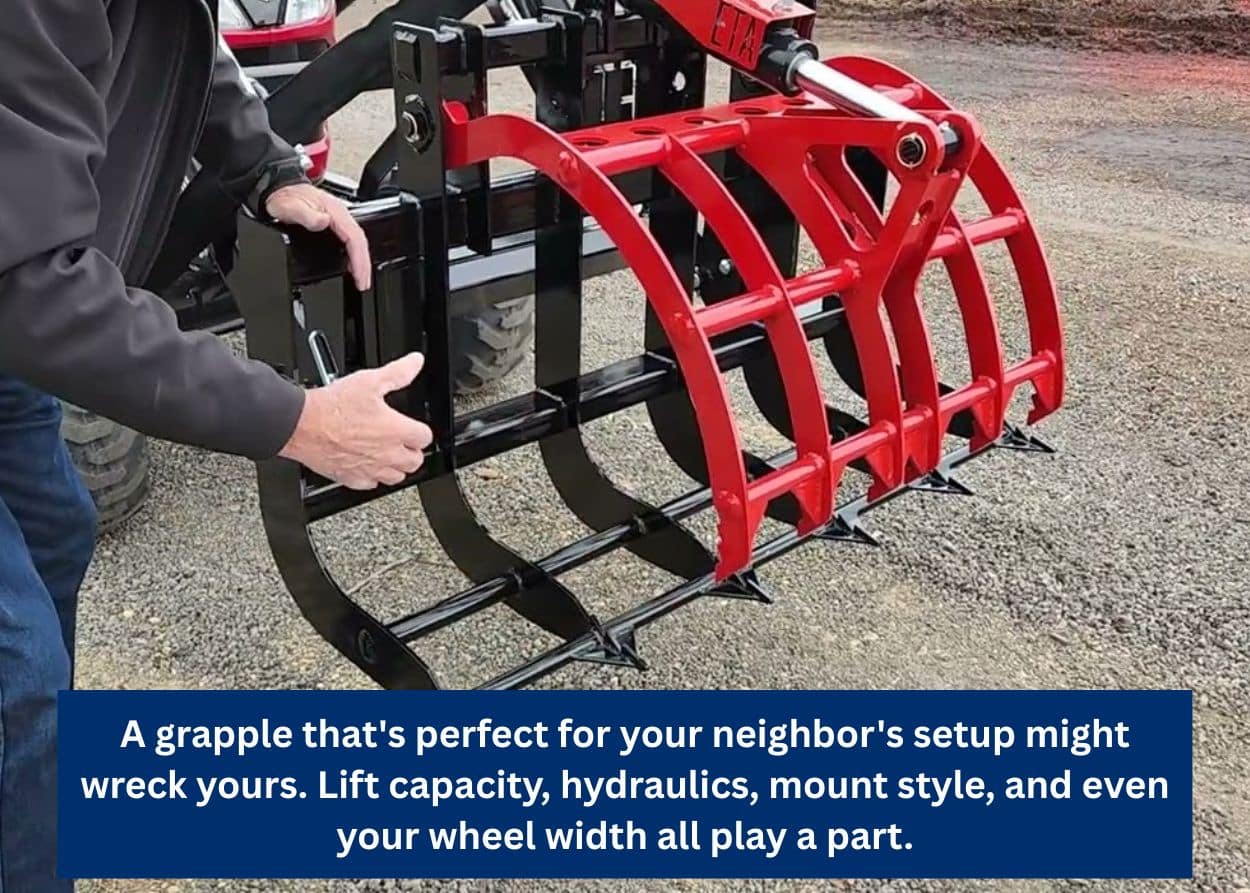
A grapple that's perfect for your neighbor's setup might wreck yours. Lift capacity, hydraulics, mount style, and even your wheel width all play a part. You need to grapple with the fact that a successful grapple purchase requires some legwork on your part.
At Earth & Turf Attachments, we've been designing attachments for compact tractors since 1997, all built right here in Lancaster County, Pennsylvania. We've helped thousands of owners avoid the "wrong grapple" mistake.
Ready to skip the headache? Here's the 6-step process to match a grapple to your tractor the right way.








TL;DR - How To Match a Grapple to Your Tractor
- Know Your Lift Capacity: Plan to use only 80% of your loader's rated lift capacity.
- Weigh the Grapple: Subtract the grapple's weight from your working capacity to find your true payload.
- Check Hydraulics: Confirm you have a third-function hydraulic valve (or budget for an aftermarket kit) to operate the jaws.
- Match Width: Select a grapple width that matches or slightly exceeds your tractor's wheel width for better stability and maneuverability.
- Confirm Mount: Verify your loader's mount style (e.g., Skid Steer Quick Attach)
- Use Ballast: Add a ballast box to your 3-point hitch to counterweight the front load, protecting your front axle and improving stability.
Step 1: Know Your Tractor's True Lift Capacity
Before anything else, you need to know how much your loader can actually lift.
You'll find this number — usually called rated lift capacity — in your owner's manual or on the manufacturer's spec sheet. It's listed in pounds and shows the maximum weight your front loader can lift.
But here's where it gets tricky.
That rated number doesn't really tell you how much you can lift in the real world. Manufacturers publish lift capacity using an SAE rating system, which measures the load in a static position — meaning the tractor is standing still on flat ground. The moment you start moving, things change. Terrain, speed, the type of attachment, and even how the load is balanced all affect what your loader can safely handle in motion.
There's another wrinkle, too. Lift capacity is usually measured at two different points:
- At the pivot pin, where the bucket attaches to the loader arms. This number is always the highest.
- At 500mm (about 19.6 inches) forward of the pivot pin — a more realistic measurement that accounts for where the load actually sits.
The further out from the pivot pin a load sits, the less weight your loader can actually lift. So your real-world capacity at the end of a grapple is usually 20–40% lower than the pivot-pin rating.
Quick rule of thumb? Never plan to lift more than 80% of your rated capacity. That gives you a safety buffer for uneven ground, sudden jolts, dynamic movement, and the natural wear that happens over time.
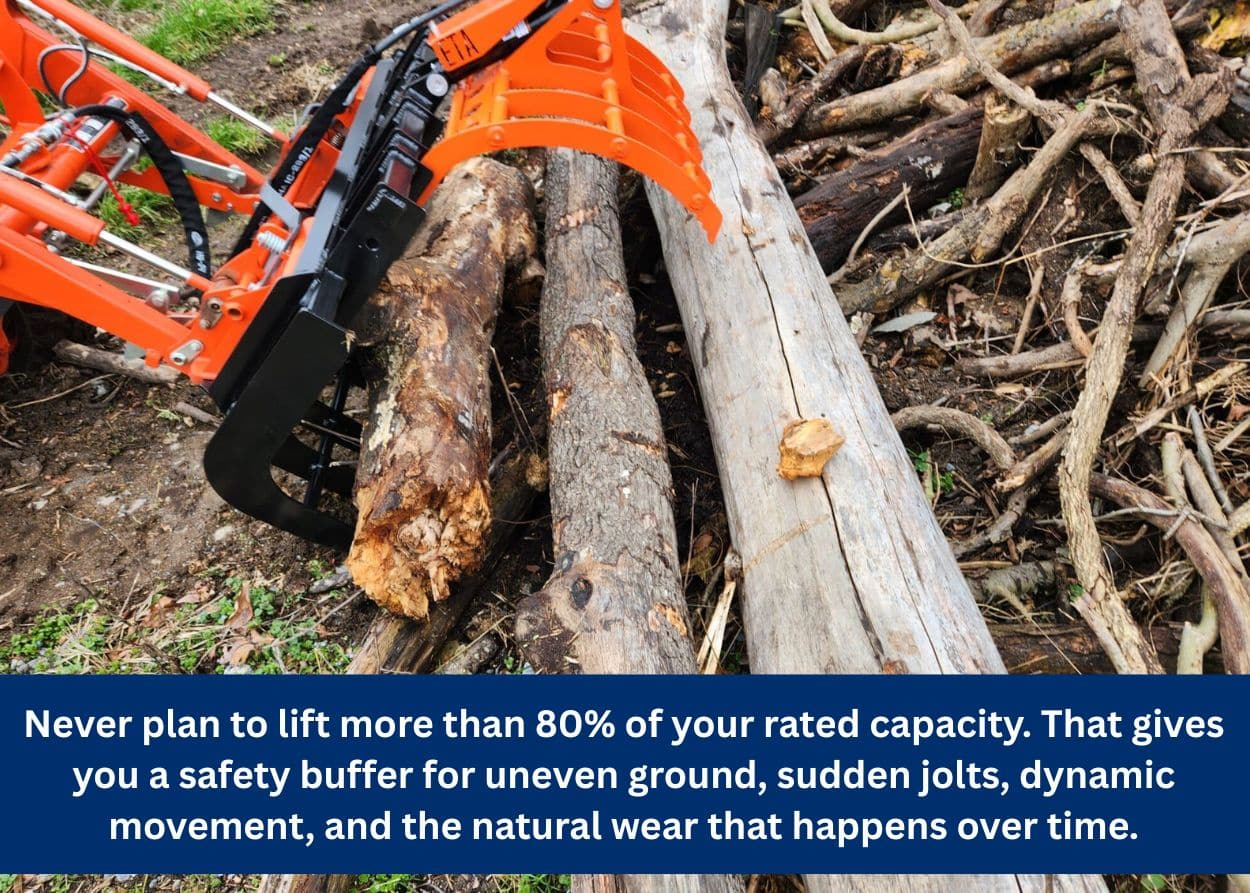
So if your tractor is rated for 1,000 lbs at the pivot pin, plan around 800 lbs of total working weight — and that includes the grapple itself.
Which brings us to Step 2.
Step 2: Weigh the Grapple Itself, Not Just the Load
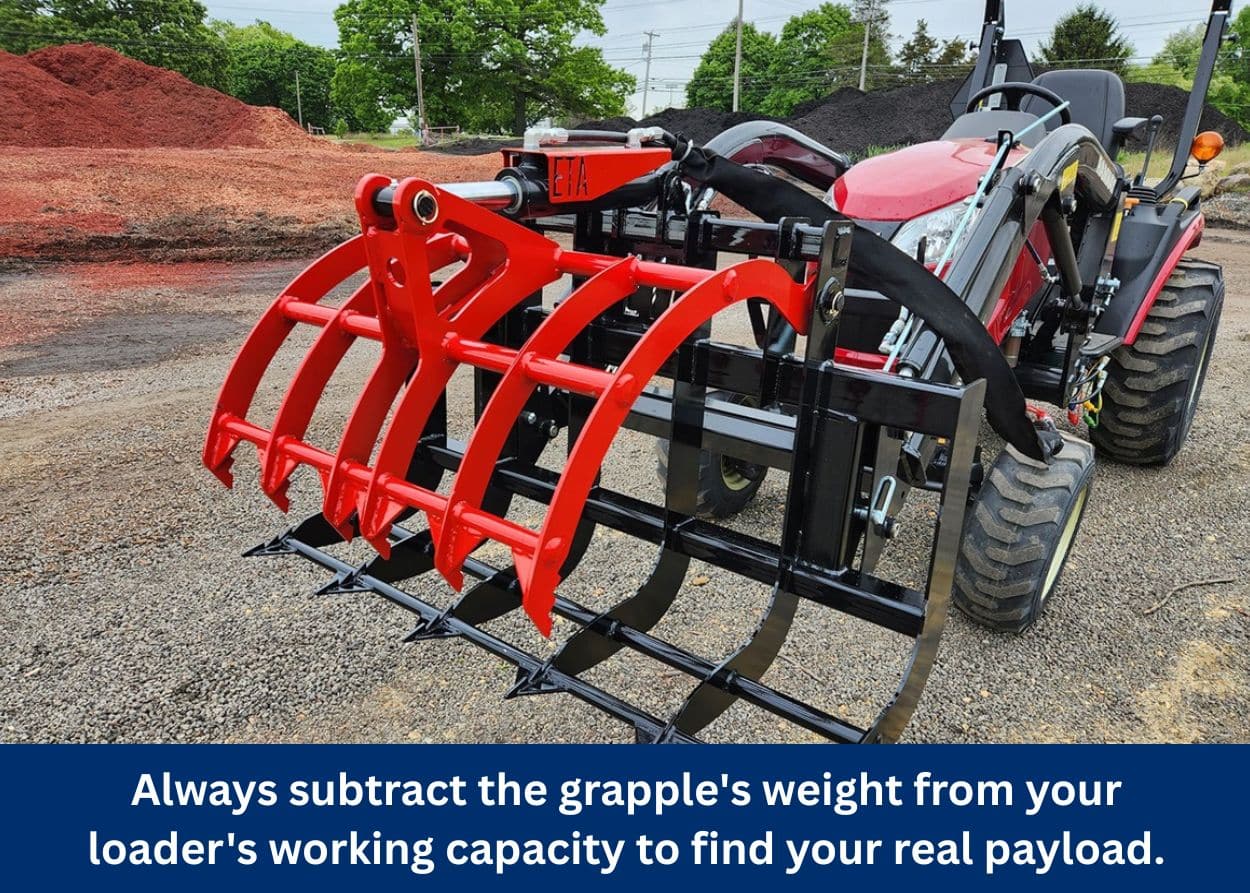
A lot of buyers miss this — Your grapple has weight, too. And every pound it weighs is a pound your tractor can't lift in actual material.
Here's the typical range:
- Sub-compact grapples: 200–300 lbs
- Compact tractor grapples: 300–500 lbs
- Skid steer/utility tractor grapples: 600–800+ lbs
Say your loader is rated for 1,000 lbs. If you apply the 80% rule, you've got 800 lbs to work with. But once you bolt on a 275 lb grapple, you're left with 525 lbs of actual lifting power for logs, brush, or rocks.
That's a significant difference from what the spec sheet promised.
The takeaway? Always subtract the grapple's weight from your loader's working capacity to find your real payload. If you're regularly hauling heavy stuff like wet logs or stones, lean toward a lighter but stronger grapple in your size range.
Step 3: Check Your Hydraulic Setup
A standard loader bucket requires only two hydraulic functions: up/down and tilt, but grapple loaders require a third to open and close the jaws.
A third-function hydraulic valve provides that extra function.
A third function hydraulic kit is a must with grapples because it opens and closes the jaws. Your grapple is just an expensive bucket without one.
Some modern compact tractors come with one built in, but older tractors might not. The good news is that you can install an aftermarket kit if your tractor doesn't have one. Just budget for it before you buy the grapple.
A couple of other things to confirm:
- Hydraulic flow: Higher flow just means faster jaw movement, not more lifting power. Don't sweat this one too much. Even modest flow rates of 4 to 10 gallons per minute are plenty for grapple work.
- Hose and coupler compatibility: This is more important than anything since your grapple won’t work without the right connections. Make sure the grapple's hoses match your tractor's quick-connect couplers. Adapters exist, but matching up the right connections before you order will be much better for your sanity.
- Hose routing: Once installed, route the hoses so they don't get pinched when you curl the loader or snagged on branches.
Step 4: Match the Width to Your Tractor
Width matters more than most people realize.
Too wide, and you lose maneuverability, not to mention stability. The grapple sticks out past your tractor and catches on trees, fence posts, and barn doors. Too narrow, and you can't get a solid grip on bigger loads, and visibility around the loader gets awkward.
So you’ll want to match or slightly exceed your tractor's wheel width.
Here's a quick guide based on tractor size:
- Sub-compact tractors (under 25 HP): 42–48" grapple
- Compact tractors (25–45 HP): 48–60" grapple
- Utility tractors (45+ HP): 60–72" grapple
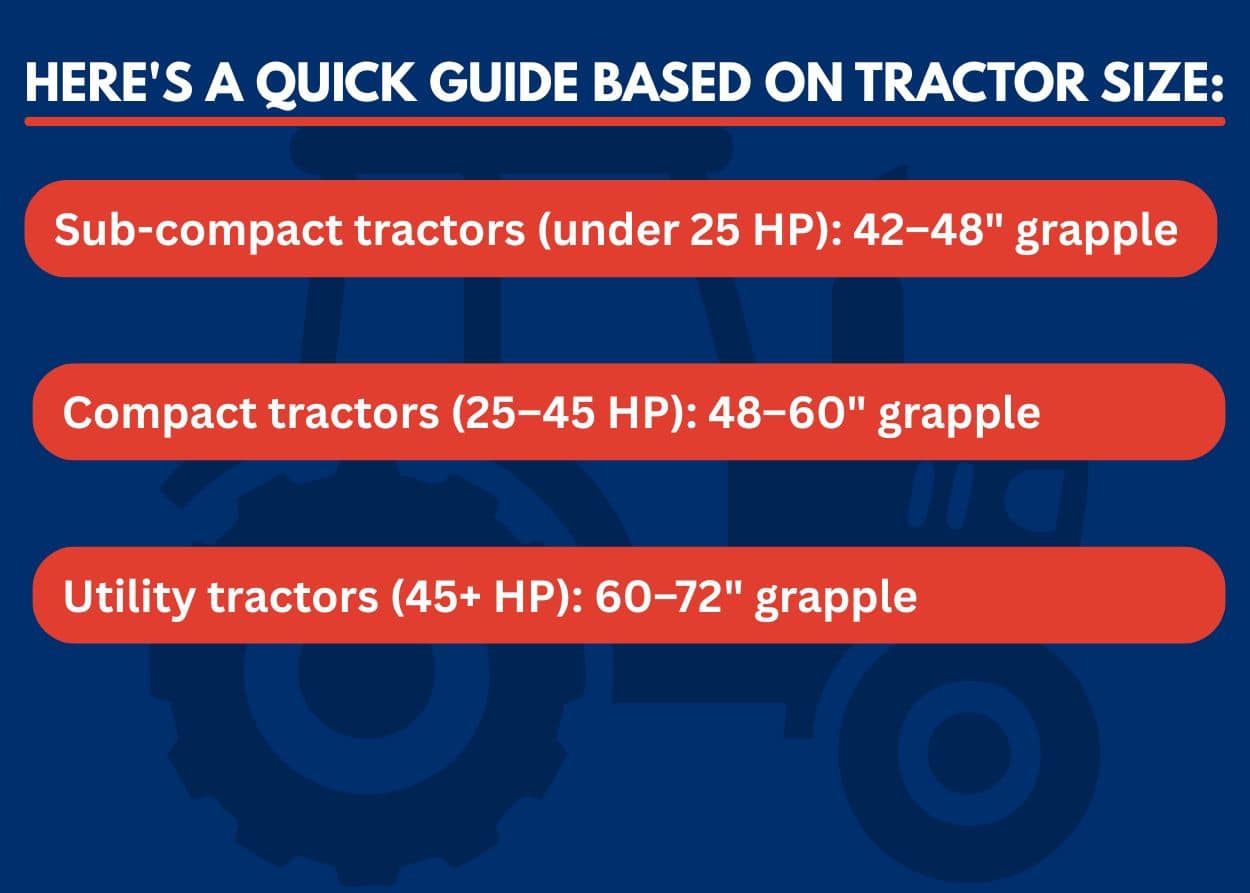
Most grapples come in widths of 42”, 48", 54", 60", and 72". Pick the one that lines up with how you actually use your tractor — not the biggest one you can technically afford.
Step 5: Confirm Mount Compatibility
This is the step that surprises first-time buyers the most.
Surprisingly, not every grapple attaches to every tractor. Mount styles vary by brand, and getting this wrong means an expensive grapple sitting on the ground while you wait for adapters.
The most common mount is the Skid Steer Quick Attach (sometimes called "universal"). Most modern compact tractors either come with this or can be converted easily. But "universal" doesn't really mean universal.
Some examples:
- John Deere tractors uses a brand-specific mounting system, but can be converted to the universal mount. Earth and Turf attachments also make John Deere-compatible attachments..
- Larger utility loaders may use a Euro mounting system, which can also be converted the the universal mount.
So, before you buy, double-check your loader's mount style and confirm the grapple either matches it or offers a conversion option.
Step 6: Don't Forget Ballast
This step protects everything you just bought, plus adds a layer of safety.
When you bolt a grapple onto your loader, you shift your tractor's center of gravity forward — sometimes dangerously so, especially if your grapple is too large for your tractor. That puts extra weight on your front axle, lightens your rear wheels, and makes the whole machine less stable on hills or uneven ground.
The fix is a ballast box on your 3-point hitch.
A ballast box counterweights the load up front, resulting in better lift capacity, safer handling, less strain on your front axle, and more stability when you're maneuvering with a heavy load.
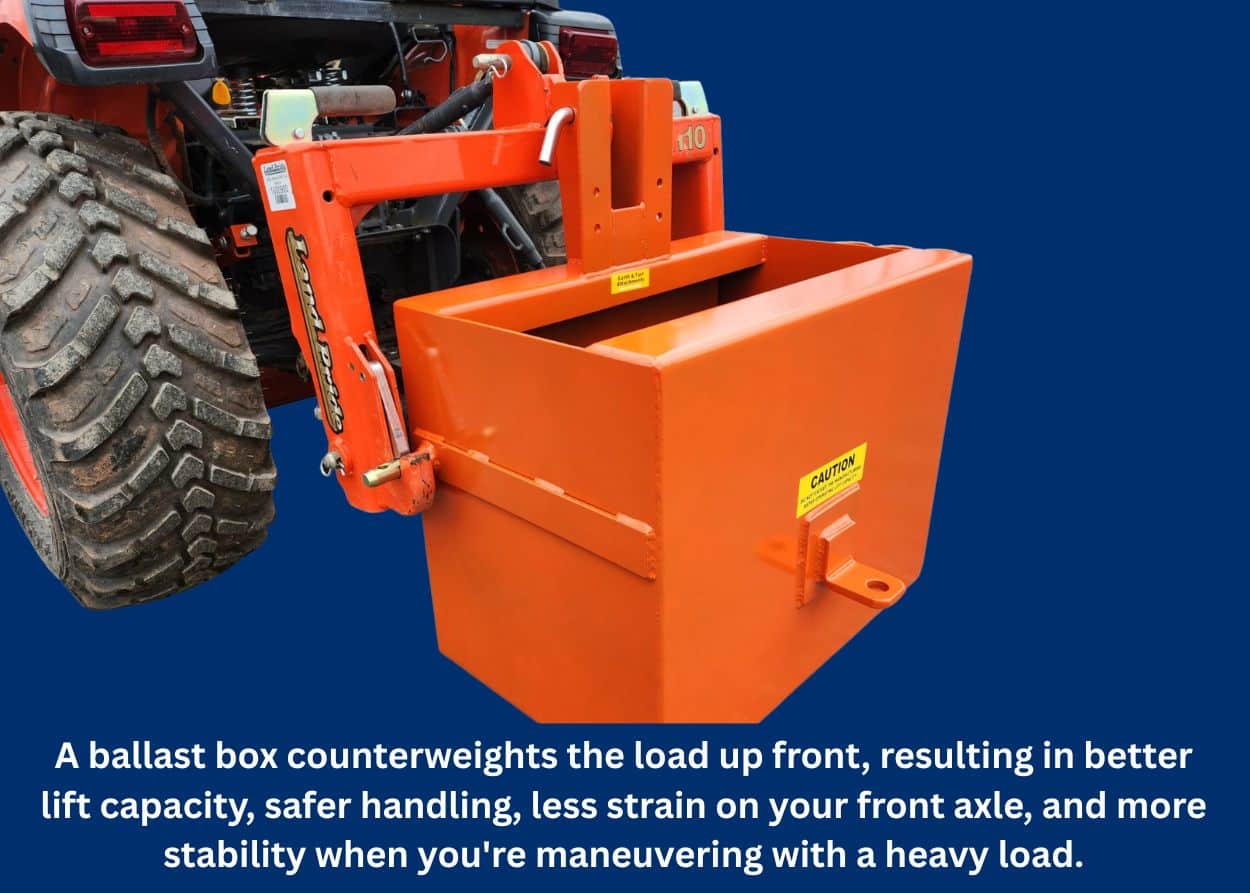
To learn more about ballast boxes, check out our guide to ballast boxes for compact tractors or browse our ballast box product page.
So don’t be that person. Skipping ballast is one of the most common — and most expensive — mistakes new grapple owners make.
Quick Reference: The 6-Step Sizing Cheat Sheet
For the skimmers, here's the whole process in one place:
- Know your loader's rated lift capacity and plan around 80% of it.
- Account for the grapple's own weight and subtract it from your working capacity.
- Confirm you have a third-function hydraulic valve or budget for an aftermarket kit.
- Match the grapple width to your tractor's wheel width and HP class.
- Check mount compatibility and order conversion plates if needed.
- Add a ballast box to counterweight the front load.
Run this list through before every grapple purchase, and you’ll never go wrong.
Why Getting It Wrong Costs More Than You Think
Skipping these steps doesn't just leave you with a grapple that underperforms.
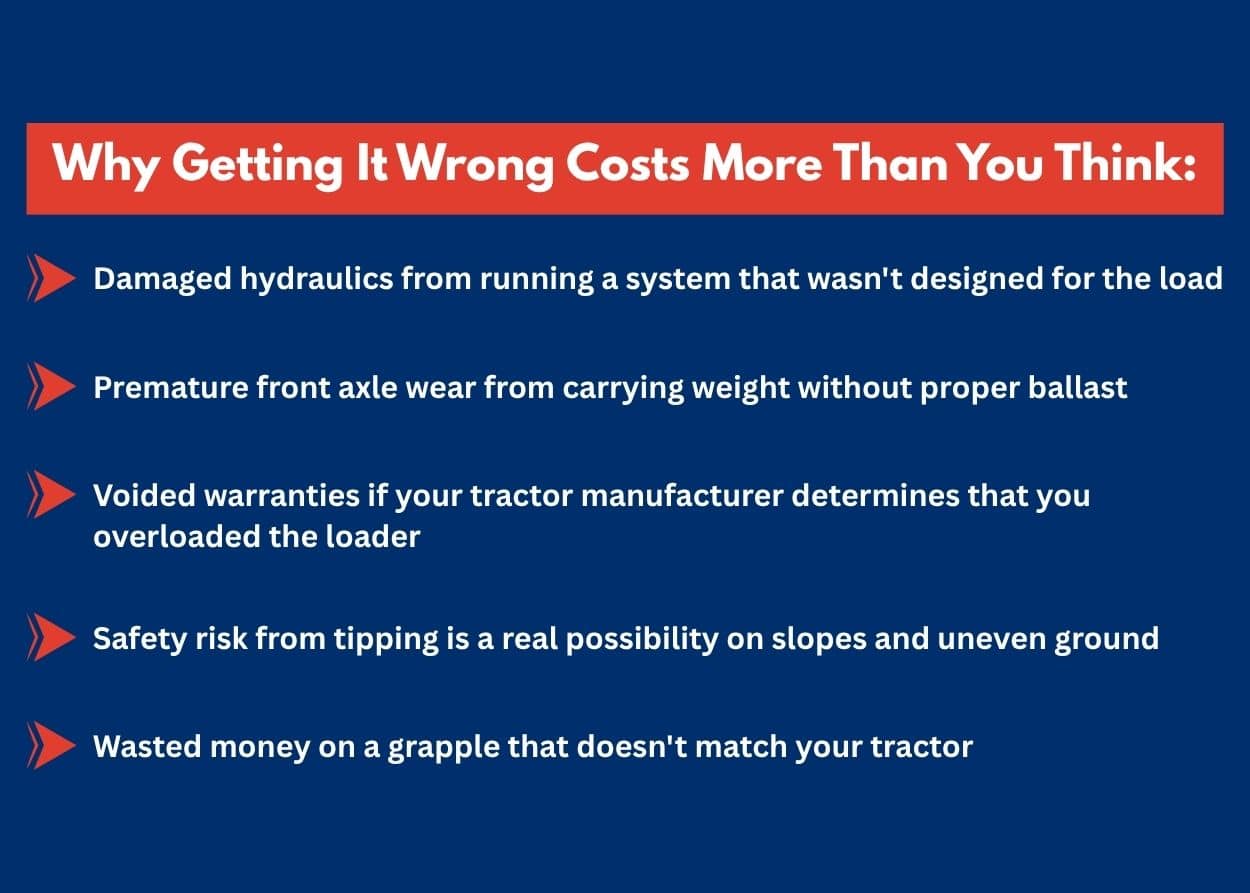
It can mean:
- Damaged hydraulics from running a system that wasn't designed for the load
- Premature front axle wear from carrying weight without proper ballast
- Voided warranties if your tractor manufacturer determines that you overloaded the loader
- Safety risk from tipping is a real possibility on slopes and uneven ground
- Wasted money on a grapple that doesn't match your tractor
A few minutes of measuring and checking specs upfront beats months of frustration or a costly repair bill down the road.
A Quick Word on Picking the Grapple Itself
Once you've confirmed your tractor can handle a grapple safely, the next question is which type fits your work. We covered that in detail in our guide to choosing the right grapple for your compact tractor, and it’s worth a read if you're still deciding between root, brush, rock, or multi-purpose.
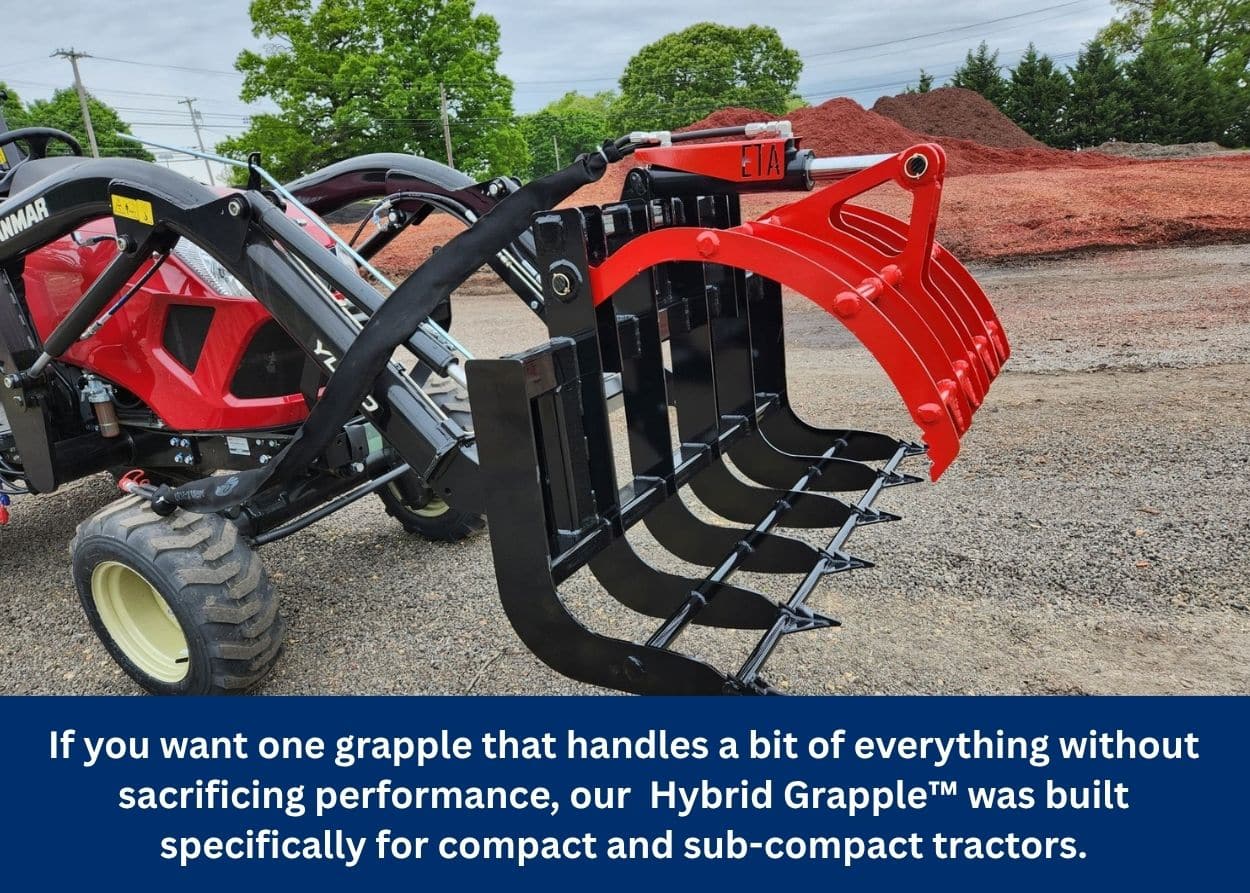
If you want one grapple that handles a bit of everything without sacrificing performance, our Hybrid Grapple™ was built specifically for compact and sub-compact tractors. It comes in 48", 54", and 60" widths, so it slots neatly into the sizing framework above.
Wrapping Up: A Grapple That Actually Fits
It’s not a lot to ask for a grapple that fits right: You drive out to the brush pile, squeeze the lever, and the jaws close cleanly around a load. The tractor lifts it without a groan, hauls it across the property, and drops it exactly where you want.
That's what happens when your grapple actually matches your tractor.
And it can be easily done through the 6 steps: Know your lift capacity. Weigh the grapple. Check your hydraulics. Match the width. Confirm the mount. Add ballast.
At Earth & Turf Attachments, we've been helping compact tractor owners get this right since 1997. Every attachment we build is made in America — specifically in Chester County, Pennsylvania, where quality artistry isn't a slogan, it's a way of life.
Got questions about which grapple fits your specific tractor? Contact us today, and we'll help you find the right match the first time.
