
Snow Pusher Maintenance: 5 Simple Ways to Keep Your Pusher Working Like New
Winter is hard on equipment.
Heavy, wet snow. Hidden ice. Gravel. Uneven driveways and parking lots.
That’s why snow pusher maintenance matters. A few simple habits stretch the life of your attachment, keep your tractor safer, and help you clear snow faster—whether you’re working a residential driveway or a commercial lot.
The good news?
You don’t need a full shop to do it.
When your snow pusher is built by a team that understands compact tractors and real winter work—like Earth & Turf Attachments in Atglen, PA—your maintenance efforts go even further. Their job? Build American-made attachments that hold up. Your job? Give your equipment a little care so it stays that way.
This guide walks through practical ways to inspect, maintain, clean, and store your snow pusher so it’s ready every time you hook up.
Here’s what we’ll cover.
Table of Contents







No time to read? Here's a summary:
- Regular maintenance matters. A few simple habits keep your snow pusher safer, longer-lasting, and more efficient all winter.
- Do a pre-season check. Inspect frame, welds, cutting edge, and wear shoes; tighten all hardware and fix anything cracked, bent, or loose before the first storm.
- Watch wear parts closely. After big storms, check cutting edges, wear shoes, and side plates for uneven wear, cracks, or chatter—adjust, flip, or replace as needed.
- Clean after use. Knock off packed snow and ice, rinse away salt and slush, then quickly inspect for bare metal, new damage, or loose bolts.
- Store it right in the off-season. Keep the pusher off wet ground, and store it dry and straight so it’s ready next winter.
- Know when to upgrade. When edges, shoes, and hardware are tired, it’s time to replace the part. When the frame or performance is failing, it’s time to upgrade the pusher itself.
Why Snow Pusher Maintenance Matters
If you know what’s at stake—staying safe in winter conditions, protecting your tractor, and avoiding breakdowns in the middle of a storm—you’re far more likely to stay on top of maintenance and prepare your equipment before the snow flies.
Good snow pusher care helps you:
- Protect your tractor and operator.
- Improve performance on every pass.
- Reduce downtime during storms.
You know why it matters. Winter puts extra strain on both you and your tractor, and even simple jobs demand more caution on snow and ice. Now let’s talk about how to do it.
Below are five simple ways to keep your snow pusher working like new. Think of them as a quick maintenance routine to follow all winter long.
1. Do a Pre-Season Walkaround
Before the first snow, give your snow pusher a quick but thorough check.
Do this once, and the rest of winter gets easier.
Check the frame and welds:
- Walk from one end of the pusher to the other.
- Look over the moldboard (main blade) and side plates to check for cracks, bends or twists, and fatigue around welds, especially at corners and edges.
Inspect the cutting edge:
Most snow pushers use a rubber cutting edge to protect the surface and give a clean scrape.
- Look for:
- Even wear across the width.
- Enough material left for another season.
- No deep cuts or missing chunks.
- Even wear across the width.
- Make sure the edge is:
- Tight against the moldboard.
- Bolted solidly with no loose hardware.
- Tight against the moldboard.
If it’s worn near the bolt heads or slots, flip it (if reversible) or replace it before winter starts.
Check wear shoes:
Wear shoes carry the pusher and protect both the cutting edge and the surface.
- Look for:
- Thin or uneven wear
- Rounded or “hooked” corners
- Cracks or broken mounting ears
- Thin or uneven wear
- Set the height based on your surface:
- Gravel/stone: Raise the edge a bit so you’re not digging rock.
- Pavement: Run the edge lower for a tighter scrape.
- Gravel/stone: Raise the edge a bit so you’re not digging rock.
- Adjust both sides the same so the pusher sits level.
Tighten hardware and mounting:
- Go over all bolts and nuts on the cutting edge, as well as wear shoes, side plates, and mounting brackets or quick-attach points.
- If you use a quick-attach or specific tractor mount:
- Make sure latch pins engage fully.
- Check for worn pins, elongated holes, or sloppy connections.
- Make sure latch pins engage fully.
If it feels loose in the shop, it will feel worse on ice.
2. Keep Cutting Edges, Wear Shoes, and Side Plates in Shape
These three things are your main wear parts. They take the abuse, so your frame doesn’t have to.
Cutting edge care (after each major storm):
- Check wear from side to side.
- Make sure it isn’t worn too close to the bolts.
- Tighten bolts so the edge stays snug and doesn’t chatter.
- Watch for these three warning signs:
- Streaks or ridges of snow behind the pusher
- Vibration or chatter when pushing
- A thin, compacted layer of snow that’s hard to remove
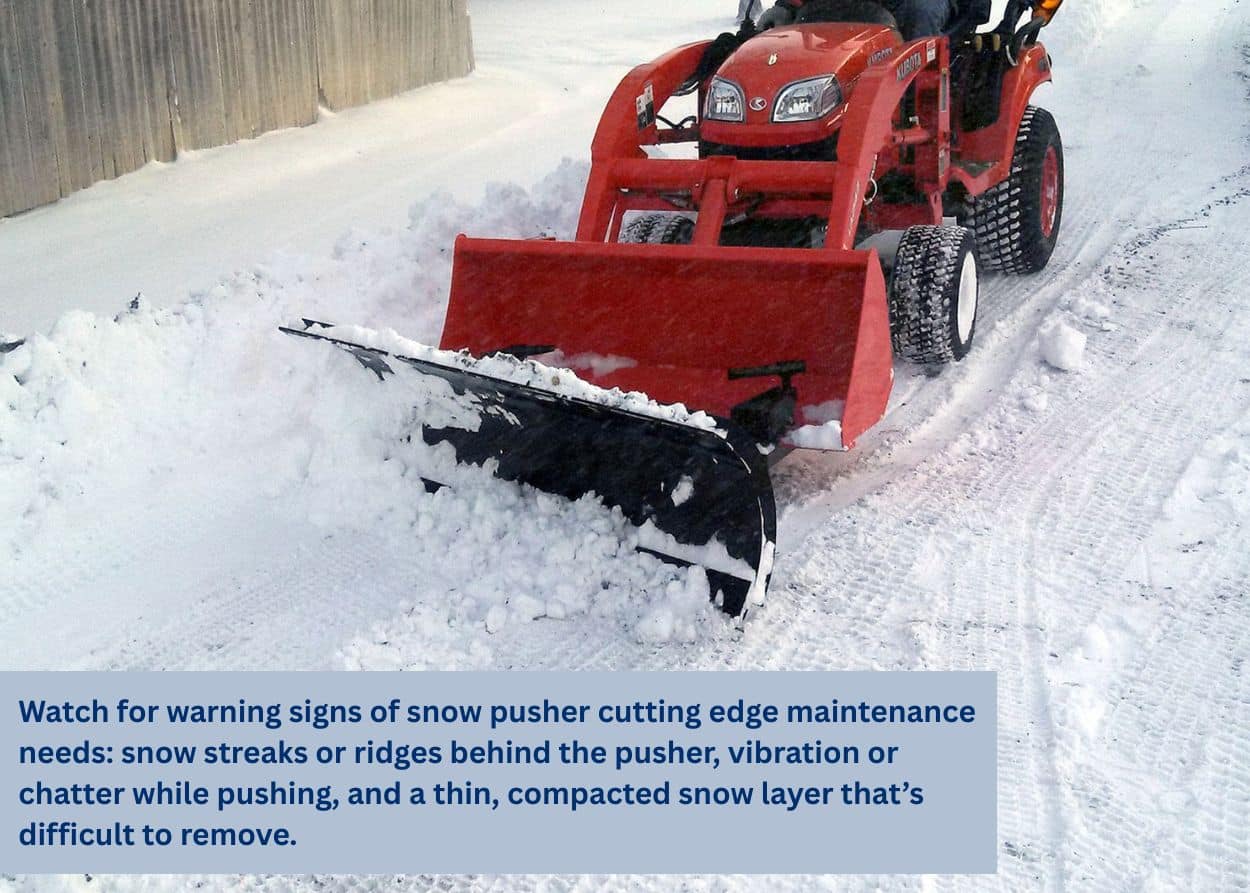
If you see these, it’s time to adjust, flip, or replace the edge.
Wear shoe care:
Wear shoes control height and help protect the cutting edge.
- Check thickness at the front and back.
- Match height to your surface (higher for gravel, lower for pavement).
- Replace them before you grind into the mounting plates.
Uneven shoes lead to uneven wear on the cutting edge.
Side plate and corner checks:
Side plates help contain snow and leave clean windrows.
- Inspect lower corners where impacts are common.
- Check outer edges for bends or cracks.
- Look at welds where side plates meet the frame.
Hairline cracks matter. A minor repair now can prevent a major failure later.
3. Rinse and Inspect After Use
You finished the driveway or lot. You're cold and tired. But a few minutes of care now can add years to your snow pusher.
First:
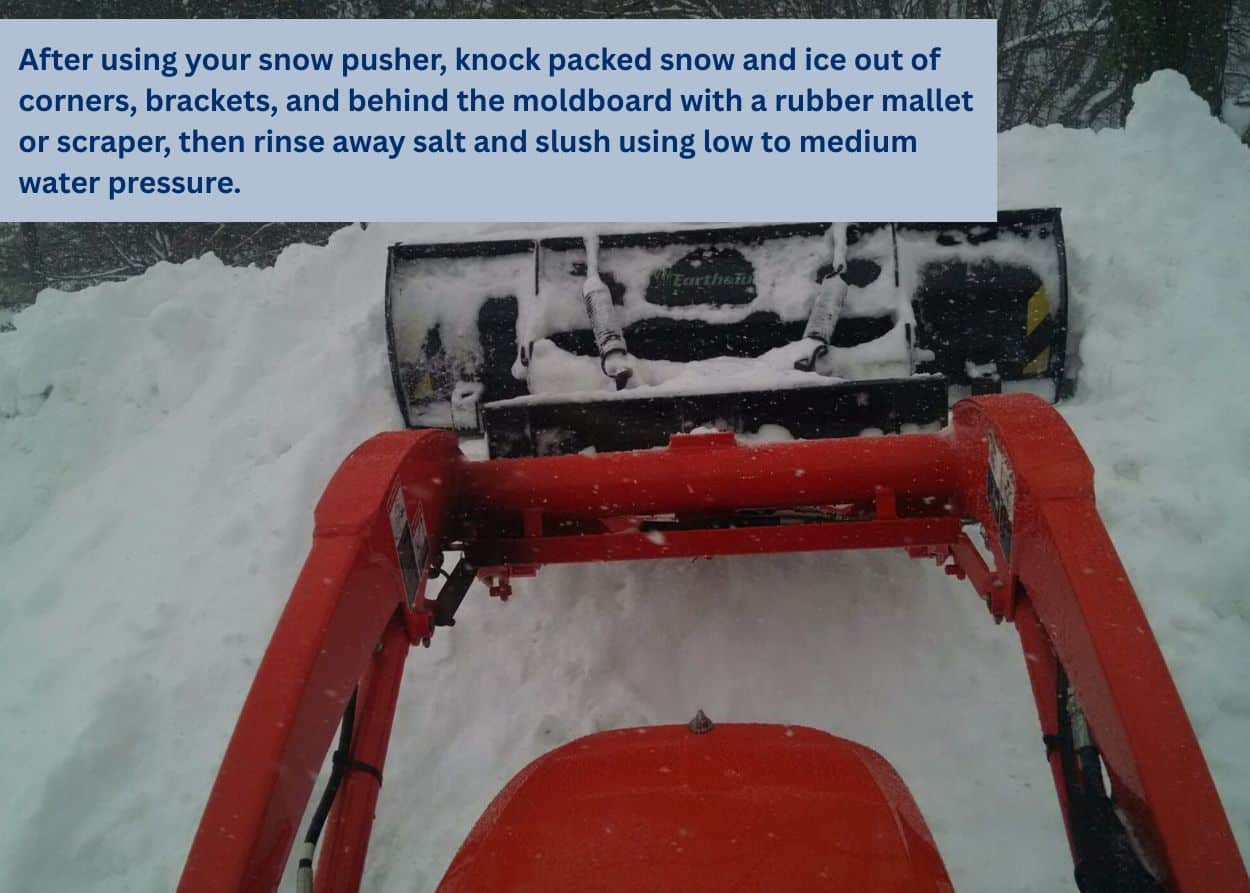
- Use a rubber mallet or scraper to knock packed snow and ice out of corners and brackets and from behind the moldboard.
- Rinse away salt and slush with low to medium water pressure.
Then, while it’s clean, do a quick post check:
- Look for fresh scratches that are down to bare metal.
- Spot new dents, bends, or cracks.
- Check again for loose bolts.
- Mark any bare steel for touch-up later.
4. Store It Smart in the Off-Season
When snow season ends, a little off-season care—especially taking time to properly prepare and store your equipment—sets you up for a smoother, trouble-free next winter.
Do a final inspection:
- Run through the same checklist you used before the season.
- Make a simple to-do list addressing any problems you find.
Touch up paint and protect bare metal:
- Wire-brush rust spots and loose paint.
- Wipe the area clean.
- Apply primer and touch-up paint.
- Lightly oil exposed bolts or hardware if needed.
Store it the right way:
- Keep it off wet ground with blocks or pallets.
- Store indoors if possible.
- If outdoors, use a tarp that sheds water but still breathes.
- Don’t stack heavy items on the moldboard or side plates.
Goal: Keep it dry, keep it straight, keep it ready.
5. Watch for Signs It’s Time to Replace or Upgrade Your Snow Pusher
Maintenance goes a long way, but not forever.
Replace wear parts when:
- Cutting edge is worn to the bolt heads – not enough material left to run safely.
- Wear shoes are paper-thin or broken – you’re grinding into the structure instead of replaceable parts.
- Hardware won’t stay tight – threads are stretched or rounded from prolonged use.
- Side plate corners are badly rounded or cracked – repeated cracking is a red flag, not normal wear.
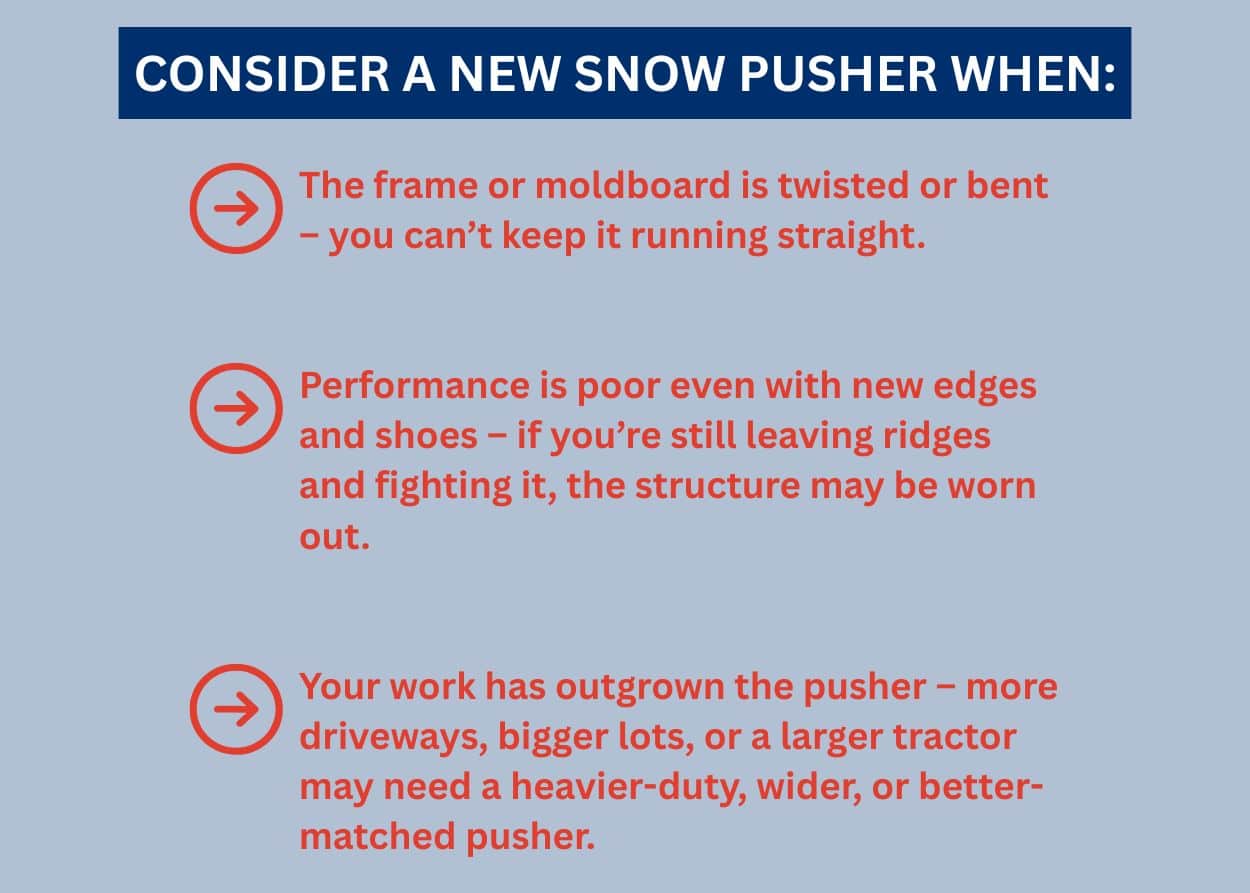
Consider a new snow pusher when:
- The frame or moldboard is twisted or bent – you can’t keep it running straight.
- Performance is poor even with new edges and shoes – if you’re still leaving ridges and fighting it, the structure may be worn out.
Your work has outgrown the pusher – more driveways, bigger lots, or a larger tractor may need a heavier-duty, wider, or better-matched pusher.
At that point, upgrading to a properly sized, heavy-duty pusher is often the smarter move—especially when you’re trusting your winters to it.
Conclusion: A Ready-For-Anything Winter Setup
Snow is demanding.
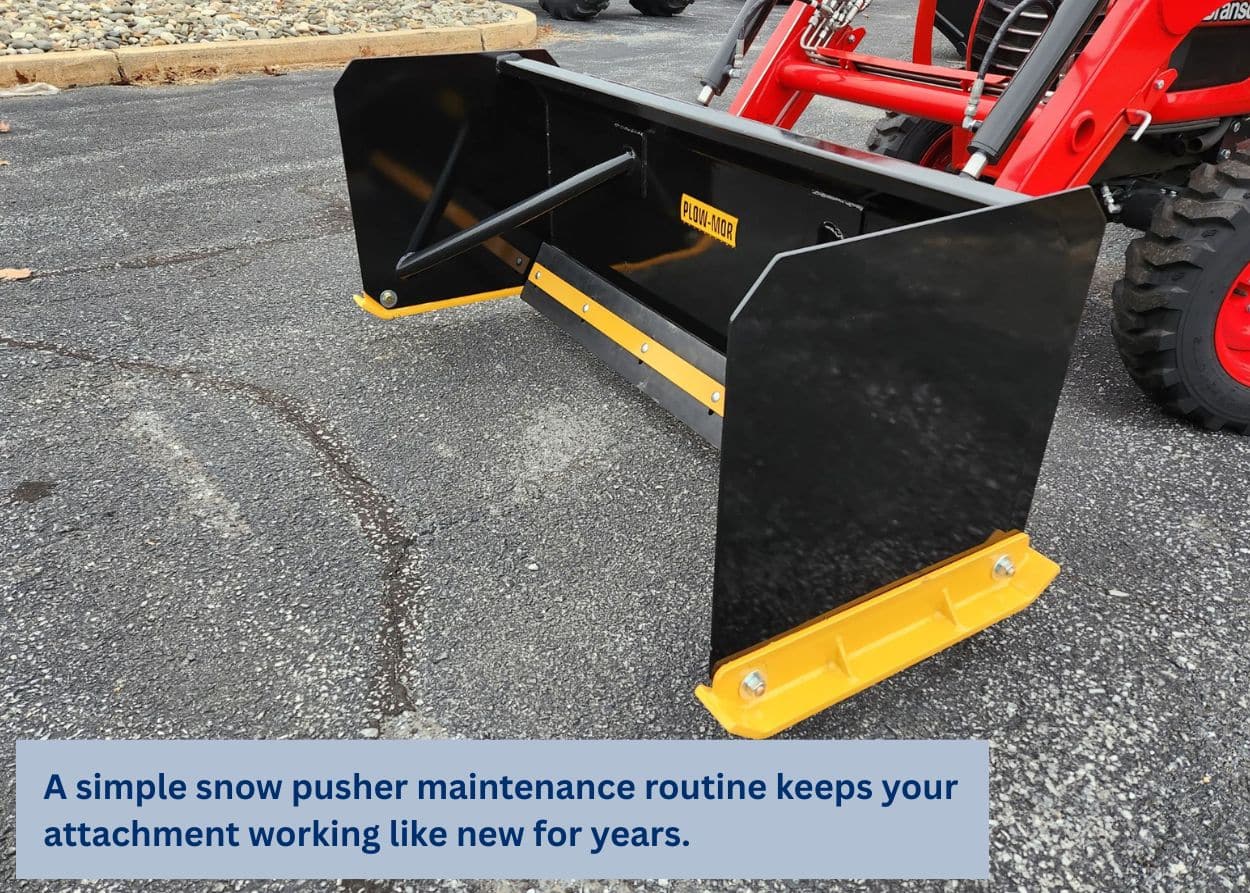
But a simple snow pusher maintenance routine—pre-season checks, quick inspections after storms, basic cleaning, and smart storage—keeps your attachment working like new for years.
Picture this:
The forecast calls for heavy snow.
You walk out to the barn or equipment shed.
Your snow pusher is straight, solid, and ready.
Bolts are tight. Cutting edge is healthy. Shoes are set.
You fire up the tractor, clear your driveway or parking lot in fewer passes, and head back inside knowing your equipment did exactly what it was built to do.
That’s the payoff of good maintenance.
Take ten minutes today to look over your snow pusher.
Make a short list of what needs attention.
Earth & Turf Attachments in Lancaster County, PA, builds snow pushers and other tractor attachments designed to match your tractor and handle real-world conditions season after season. Reach out to us for tools that help your tractor work smarter all winter long.
Read more about our compact tractor attachments here:
Revolutionize Your Projects: Exploring the Best Compact Tractor Attachments
